The useful starting point
A poor reading may identify a useful investigation, but it does not select a capacitor bank or prove a bill saving. Understand the quantity, tariff and operating condition first.
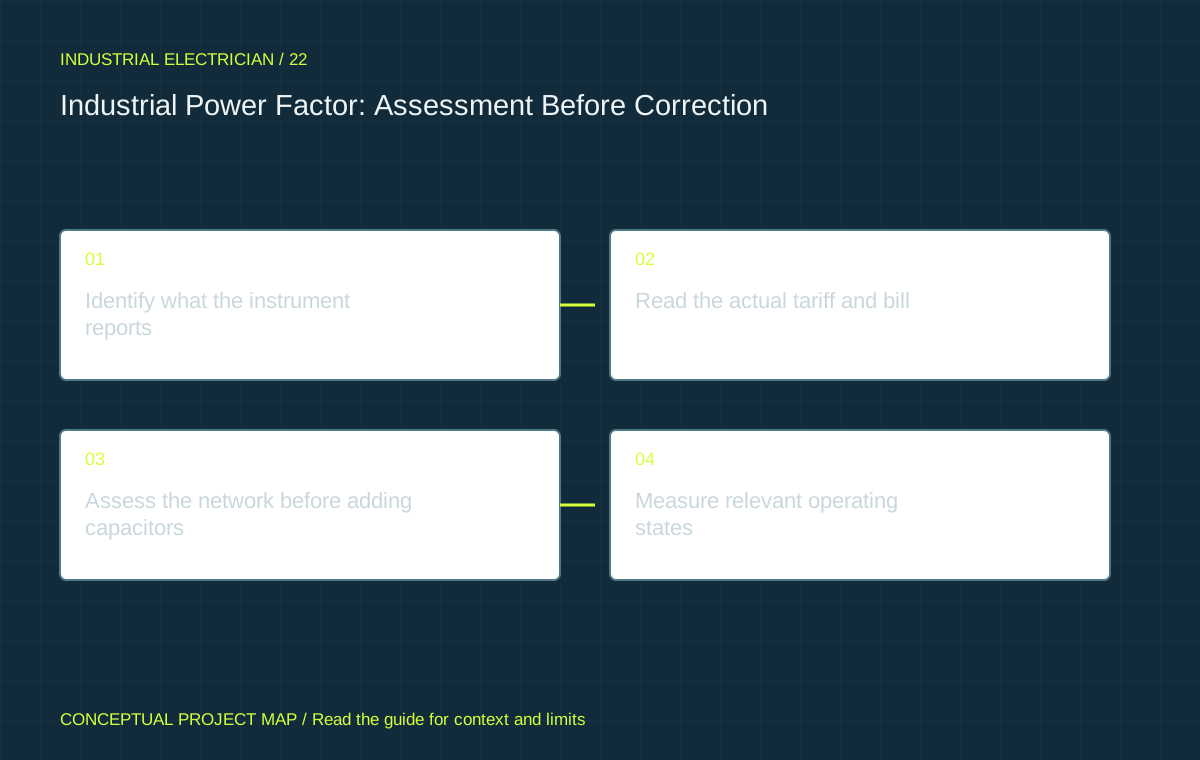
Identify what the instrument reports
Power factor relates real and apparent power. Schneider Electric distinguishes true power factor from displacement power factor. The latter considers the fundamental-frequency relationship; the former includes harmonic effects.
Record the meter definition, location, sign convention and operating condition. A value from one lightly loaded motor does not establish the whole facility’s billing behaviour.
Read the actual tariff and bill
Whether correction changes the bill depends on the site’s applicable terms, metering and duty. Review current bills and the relevant tariff. Do not promise savings by multiplying a poor power-factor number by energy charges.
Separate energy, demand and any power-factor provisions. A change can affect apparent current without producing the simple energy reduction a salesperson implies.
Assess the network before adding capacitors
Drives and other nonlinear loads can affect the correction design. Existing capacitor equipment and system impedance need review. An unsuitable arrangement can create undesirable interactions.
Schneider describes detuned capacitor-bank products intended to limit resonance and harmonic amplification. That is product-specific information, not a recommendation for a particular facility. Selection requires the actual assessment.
Measure relevant operating states
Compare shifts, production levels and starts using an appropriate monitored period. The qualified specialist determines instruments, access and the analysis. Record how the proposed target and equipment accommodate changing loads.
Where a plant also has trips or overheating, coordinate the work with a wider power quality investigation rather than treating each symptom separately.
Verify the installed result
Define acceptance around the measured problem, operating range and applicable billing terms. Record commissioning evidence and maintenance requirements, then review the programme when the plant adds or changes significant loads.
No correction size, switching design or financial guarantee is provided here. The project scope should request a site-specific assessment and clear limitations.
Questions / Direct answers
Common questions
Does better power factor always reduce kWh?
No. Power factor and energy use are different quantities. Financial effects depend on actual losses, duty and applicable billing terms.
Can a capacitor bank be sized from one meter reading?
That is insufficient for a complete design. Operating variation, waveform behaviour, existing equipment and network characteristics need review.
Are true and displacement power factor interchangeable?
No. Their definitions differ, especially when current waveform distortion is present. State which quantity is being reported.
References / Jurisdiction matters
Sources & further reading
Confirm the actual location, permit authority and equipment instructions before relying on a requirement. A source from another jurisdiction is identified for context.
- True and displacement power factorSchneider Electric · 2026-10-07
- Power factor correction and detuned capacitor banksSchneider Electric; product-specific guidance · 2026-10-07
Do not open equipment, handle refrigerants or work on energized systems. Permits, qualified trades and inspection requirements vary by location. This guide does not design an installation or certify existing equipment.