The useful starting point
The transformer’s nameplate is a starting point. Its application depends on the source, the downstream loads and the place in which it must operate.
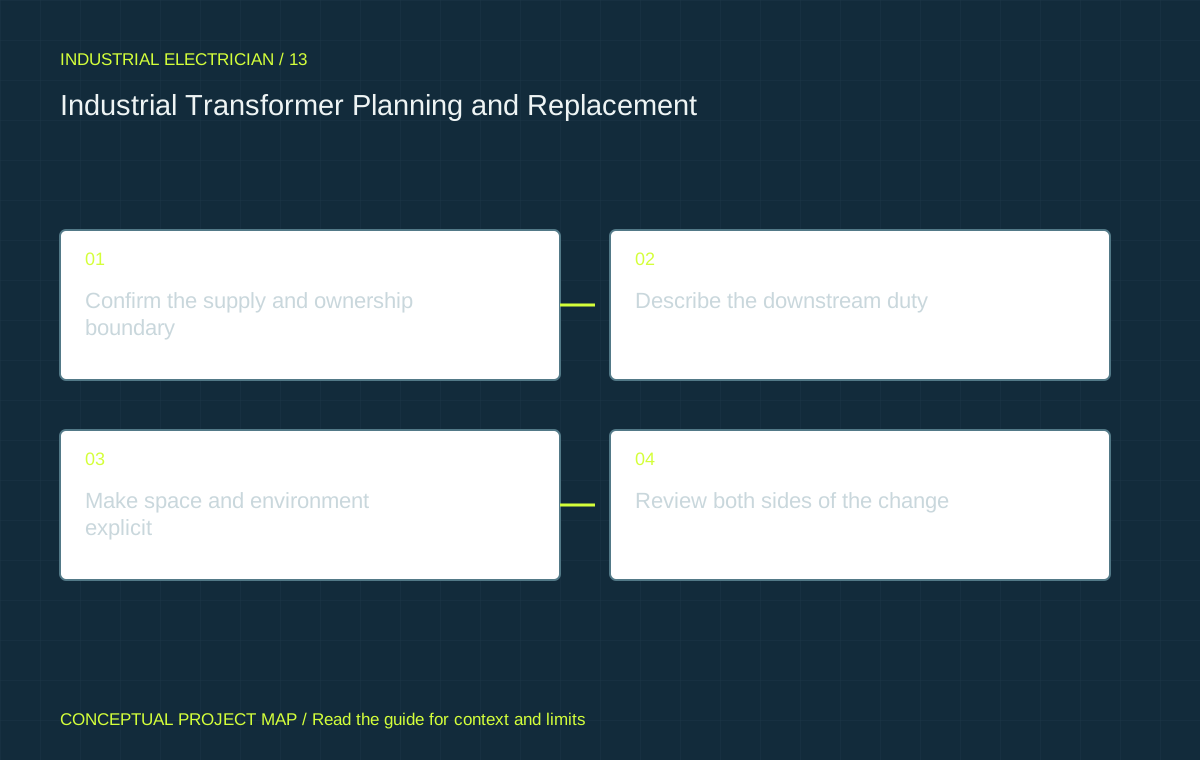
Confirm the supply and ownership boundary
Identify the actual source, voltage and system arrangement through current documentation and qualified assessment. Determine whether the transformer is customer-owned and which utility requirements apply. A distribution utility’s service arrangement should not be inferred from the building address alone.
For a new or altered connection, engage the utility early. The utility feasibility process and the customer’s transformer design have related but distinct responsibilities. Record both in the project scope.
Describe the downstream duty
Collect the complete load requirements, including motors, drives, welding, heating and sensitive controls as relevant. Duty, starting and nonlinear loading can affect the application. Summing catalogue ratings does not describe every operating case.
Ask the designer to address the applicable rating, voltage behaviour, thermal conditions and protection. The power quality chapter is useful when existing loads have unexplained trips or waveform concerns.
Make space and environment explicit
Assess location, ventilation, contamination, noise concerns, service access and the route for installation or future removal. A replacement that fits the floor area may still need different cooling or clearance arrangements.
Include structural, civil and fire-related coordination where required. For outdoor or process-exposed equipment, the complete installation must suit the environment. State who provides those assessments and associated work.
Review both sides of the change
A transformer change can affect fault levels and protection assumptions upstream and downstream. The review must include the relevant system studies, device ratings and operating configurations.
Do not swap equipment solely because kVA and nominal voltages match. Configuration, impedance, duty, interfaces and the actual installation need review. Approved settings and the field arrangement must be reconciled at commissioning.
Plan acceptance and restart
Define applicable tests and manufacturer requirements before the outage. Arrange equipment movement, connections, specialist attendance and utility release where required. Coordinate testing with connected electronics and the qualified test team’s methods.
Handover should include transformer information, updated drawings, relevant test records and maintenance requirements. The shutdown plan must cover production recovery, not merely the time taken to exchange the equipment.
Questions / Direct answers
Common questions
Is kVA enough to choose a replacement transformer?
No. Source and load arrangements, impedance, duty, environment, protection, interfaces and applicable requirements must also be reviewed.
Does a larger transformer solve every capacity problem?
No. The utility connection, upstream equipment, downstream distribution and protection can remain constrained. Assess the full path.
Should transformer replacement update an arc flash study?
The responsible engineer should review the effect on the study and protection assumptions. Do not keep old results by default after a material system change.
References / Jurisdiction matters
Sources & further reading
Confirm the actual location, permit authority and equipment instructions before relying on a requirement. A source from another jurisdiction is identified for context.
- Electrical codes and standards currently in forceAlberta Municipal Affairs · 2026-10-07
- Meter installation and energization processENMAX Power · 2026-10-07
- Service connections in EdmontonEPCOR · 2026-10-07
- True and displacement power factorSchneider Electric · 2026-10-07
Do not open equipment, handle refrigerants or work on energized systems. Permits, qualified trades and inspection requirements vary by location. This guide does not design an installation or certify existing equipment.